
The Agent Who Posted Once and Got 14 Leads in a Week
Marcus had been a licensed insurance agent for six years. He ran cold call campaigns, knocked doors, and attended every local networking event he could find. His pipeline was decent — but exhausting to maintain.
Then a colleague suggested to try the social media marketing for insurance agents. So he try posting on LinkedIn. Not ads. Not promotions. Just a short post explaining the difference between term and whole life insurance in plain English.
He published it on a Tuesday morning. By Friday, it had been shared 47 times and his inbox had 14 messages from people asking for quotes.
That one post changed how Marcus thought about marketing forever.
This isn’t a one-in-a-million story anymore. According to HubSpot’s 2025 State of Marketing report, businesses using social media for lead generation see a 45% higher lead-to-close rate compared to outbound-only strategies. For insurance agents — where trust drives every sale — that gap is even more pronounced.
If you’re not using social media intentionally and consistently, you’re leaving a significant portion of your potential client base on the table. This guide gives you exactly what you need to change that.
The Trust Gap Is Your Biggest Opportunity
Insurance is not an impulse purchase. People don’t wake up on a Tuesday and randomly decide to buy a policy from a stranger. They research, compare, hesitate — and eventually buy from whoever they trust most.
Most insurance consumers actually prefer to call an agent before going ahead with a policy. This “trust gap” represents the sweet spot where social media marketing for insurance agents becomes invaluable for insurance professionals.
Social media is how you build that trust before the phone call ever happens. When a prospect sees your face, reads your explanations, and watches you answer real questions week after week — by the time they reach out, they already feel like they know you. That’s an enormous advantage over every agent who’s invisible online.
The Numbers Don’t Lie
The data behind social media’s role in insurance marketing is compelling:
- 69% of insurance consumers ran a search before scheduling an appointment, and 78% of insurance consumers call a business after running that search.
- Nearly 90% of consumers rely on social media to keep up with trends and cultural moments, according to Sprout Social, with that number trending upward over time.
- 74% of consumers research insurance purchases online, but only 25% end up making a purchase online — meaning most still want a human agent to close the deal.
- Around 62% of consumers say that speaking with an agent is the most important step in their decision-making process.
The pattern is clear: consumers start online and finish with a human. Social media is where that journey begins — and where you need to show up.
Choosing the Right Platforms: Where Should Insurance Agents Be?
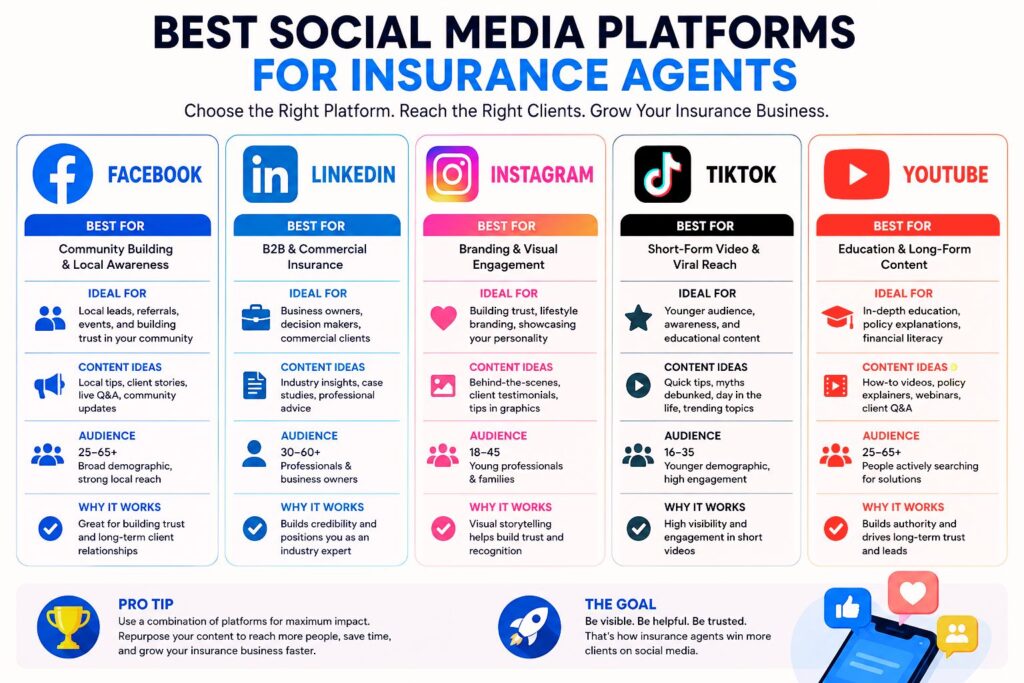
Not every platform deserves your time and energy. The best platforms for social media marketing for insurance agents include Facebook, LinkedIn, Instagram, and YouTube, where agents can focus on simplifying complex topics, engaging with their audience, and establishing trust. Here’s how to think about each one:
Facebook — Best for Local Community Building
Facebook, with around 2.9 billion monthly active users, is a leading platform for insurance companies to enhance brand visibility and engage with a wide audience. Its vast user base makes it ideal for insurance marketing. You can use this platform to create a business page to share updates and insights, use targeted ads, engage with customers, and share educational content.
Facebook’s ad targeting is particularly powerful for local agents. You can target homeowners in specific zip codes, new parents, small business owners, and other high-intent demographics — all within a defined radius of your office.
Best for: Auto, home, life, and Medicare supplement agents targeting local families and homeowners.
LinkedIn — Best for Commercial and B2B Insurance
LinkedIn is ideal for B2B social media marketing for insurance agents and professional networking. Its professional focus suits B2B insurance marketing, letting you connect with industry experts and potential clients.
LinkedIn has over 1.2 billion members, and more than half of LinkedIn user households earn over $100,000 a year. For agents selling commercial lines, group benefits, professional liability, or key-person life insurance, this audience is precisely who you want to reach.
Best for: Commercial lines, group benefits, business owners, and high-income professionals.
Instagram — Best for Visual Storytelling and Under-40 Audiences
Instagram Reels have proven remarkably effective for simplifying complex insurance topics — and the algorithm tends to favor this format, meaning your content can reach far beyond your existing followers.
Instagram works best for agents who want to build a recognizable personal brand, showcase their community involvement, and reach younger buyers purchasing their first auto, renters, or life insurance policies.
Best for: Personal lines agents, younger demographics, brand building.
TikTok — Best for Reaching First-Time Buyers
TikTok’s short-form video format is effective in reaching younger audiences through social media marketing for insurance agents. You can create entertaining, informative clips about policies, join trending challenges, and use popular hashtags.
Don’t underestimate TikTok’s power for insurance. A 60-second explainer on why renters insurance costs less than a Netflix subscription can reach tens of thousands of potential first-time policyholders — for free.
Best for: Life, renters, and auto agents targeting millennials and Gen Z.
YouTube is the long game of insurance social media marketing. A well-made 8-minute video explaining Medicare Part A versus Part B can generate quote requests for years after it’s published. YouTube content has exceptional longevity — an insurance integration in a well-ranking personal finance video can generate quote referrals for months or years after initial publication.
Best for: Medicare, life, and complex product agents who want evergreen lead generation.
Strategy 1: Follow the 80/20 Content Rule
This is the single most important principle in social media marketing for insurance agents. The most successful insurance agents on social media follow a simple but powerful content ratio: an 80/20 approach that recognizes people don’t go on social media hoping to see more ads — they’re there to learn, be entertained, or connect with others.
In practice:
- 80% educational, helpful, or entertaining content — tips, explainers, myth-busting, Q&A, behind-the-scenes
- 20% promotional content — policy highlights, special offers, direct calls to action
If every post is a sales pitch, people unfollow. If every post teaches them something useful, they stay — and eventually buy.
Strategy 2: Go All-In on Short-Form Video

Video content, particularly short-form videos, will continue to dominate digital marketing in 2026. Instagram Reels, YouTube Shorts, TikTok, and even LinkedIn videos are becoming powerful tools for education and brand-building in insurance.
You don’t need a production studio. You need a smartphone, decent lighting, and a genuine willingness to show up on camera. You don’t need studio-quality production — in fact, authentic, clear, and helpful videos often do better than polished ads. The goal is familiarity and trust, not perfection.
Start with these proven video formats:
- “Did You Know?” — surprising insurance facts in 30–60 seconds
- Coverage explainers — “What does comprehensive car insurance actually cover?”
- Myth-busting — “3 things people get wrong about life insurance”
- Day in the life — behind-the-scenes of your agency
- Client success stories — with permission, share how a policy helped someone
The key is to break down one specific concept per video rather than trying to cover everything at once.
Before you post a single piece of content, your profiles need to be set up correctly. A half-finished profile kills credibility instantly.
Every profile should include:
- Professional headshot — not a logo, not a casual selfie. A clear, friendly, professional photo.
- Keyword-rich bio — include what you do, who you help, and where you’re located
- Contact information — phone number, email, website link
- Consistent branding — same colors, fonts, and tone across all platforms
- Call to action — “Get a free quote” or “Book a 15-minute call” with a direct link
Whether you are a captive agent or an independent insurance agent, creating a professional and consistent presence across platforms is crucial for credibility and brand recognition.
Strategy 4: Post Consistently — Not Perfectly
The agents who win on social media aren’t the ones with the most polished content. They’re the ones who show up consistently. Setting a clear objective, such as committing to publish at least one original piece of content weekly to educate your clients and prospects, is crucial. In the realm of content, quality invariably outweighs quantity.
A realistic posting schedule for a solo agent:
| Platform | Recommended Frequency |
|---|---|
| 3–5 times per week | |
| 2–3 times per week | |
| 3–4 times per week | |
| TikTok | 3–5 times per week |
| YouTube | 1–2 times per week |
Start with one or two platforms and do them well before expanding. Consistency on two platforms beats sporadic posting on six.
Consumers are increasingly skeptical of ads that promise savings without context. In 2026, educational marketing will outperform promotional messaging. Providing educational content positions agents as advisors rather than salespeople while building long-term loyalty.
Content ideas that consistently perform well for insurance agents:
- Seasonal reminders (“It’s hurricane season — here’s how to review your home coverage”)
- Coverage comparison posts (“Term vs. Whole Life: Which one is right for you?”)
- Cost breakdowns (“Why your car insurance went up — and what you can do about it”)
- Local risk awareness (“Homeowners in [your area] — are you covered for wildfires?”)
- Policy myth-busting (“Your health insurance does NOT cover this — read this first”)
Your educational content should address the real concerns and knowledge gaps your clients face. Consider seasonal risks — as hurricane season approaches, share practical preparation tips that also subtly remind homeowners to review their coverage.
Strategy 6: Engage Actively — Don’t Just Broadcast
Social media is not a billboard. It’s a conversation. Engagement is the foundation of successful social media marketing. Agents should prioritize timely responses to comments, messages, and inquiries to show responsiveness and build trust. Engaging with your audience not only strengthens relationships but also fosters loyalty and encourages potential clients to reach out.
Practical engagement habits to build:
- Respond to every comment within 24 hours
- Reply to DMs same day — especially on Facebook and Instagram
- Like and comment on your followers’ posts, not just your own
- Ask questions at the end of your posts to invite responses
- Run polls about insurance concerns or coverage questions
- Thank people publicly when they share your content
Social media encourages direct conversations. It lets insurance agents quickly address questions, provide updates, and build relationships.
Strategy 7: Leverage Facebook Ads for Targeted Lead Generation
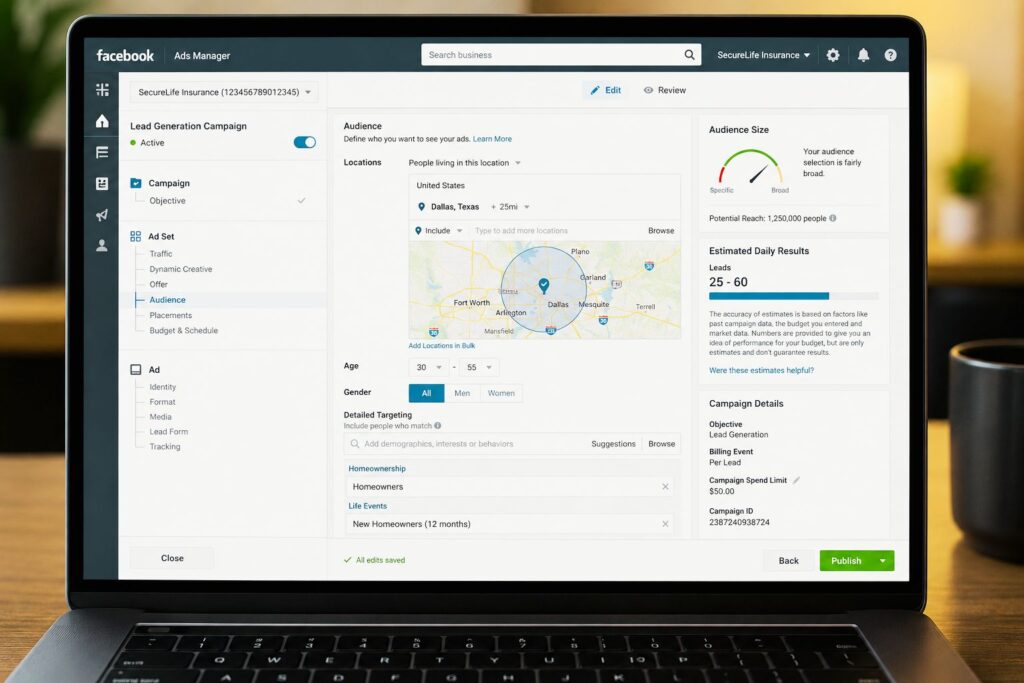
Organic social builds trust. Paid ads accelerate it.
Facebook advertising is one of the most cost-effective lead generation tools available to insurance agents. You can target by location, age, homeownership status, life events (new baby, new home, new job), and dozens of other factors that signal insurance need.
Facebook’s ad targeting is highly effective for insurance lead generation. You can target homeowners in specific zip codes, new parents, small business owners, and other high-intent demographics with lead-form ads that capture contact information without requiring a website visit.
Start with a simple lead generation campaign:
- Create a Facebook Lead Ad (no website needed)
- Target homeowners aged 30–55 within 25 miles of your office
- Offer something valuable — a free coverage review, a rate comparison, or a risk assessment
- Follow up within the first hour — phone calls consistently outperform digital leads, converting 10 to 15 times higher than web-based inquiries.
A budget of $10–$20 per day is enough to test and learn before scaling what works.
Nothing sells insurance like other people’s trust. Encouraging satisfied clients to leave testimonials on social media platforms can serve as powerful social proof, helping to attract potential customers, improve client retention, and establish credibility.
Ways to build and display social proof:
- Ask happy clients to post a review on your Facebook Business Page
- Share (with permission) written or video testimonials on your feed
- Post anonymized client success stories (“A client came to me after a claim was denied — here’s how we fixed it”)
- Screenshot and share 5-star Google reviews on your Instagram Stories
- Create a “Client Spotlight” series showcasing how specific coverage helped real people
Referral leads have a 30% higher conversion rate than leads from any other source — and a visible wall of social proof on your profiles functions as a 24/7 referral machine.
Strategy 9: Track Your Metrics and Adjust
Set clear and measurable goals. For example, aim to boost brand awareness by growing followers by 20% in six months, generate 50 new leads per month, and achieve a 10% engagement rate on your posts.
The four metrics every insurance agent should track:
| Metric | What It Tells You |
|---|---|
| Engagement Rate | Are people interested in your content? |
| Reach & Impressions | How many people are seeing your posts? |
| Click-Through Rate | Are people visiting your website or quote page? |
| Lead Conversions | How many social media contacts became clients? |
Regularly reviewing your social media management helps refine strategies and maximize results. Use tools to track engagement rates, reach, impressions, conversions, and click-through rates to measure success. Test different approaches, experiment with various content types and posting schedules to identify what resonates most with your audience.
What to Post: A 30-Day Content Calendar for Insurance Agents
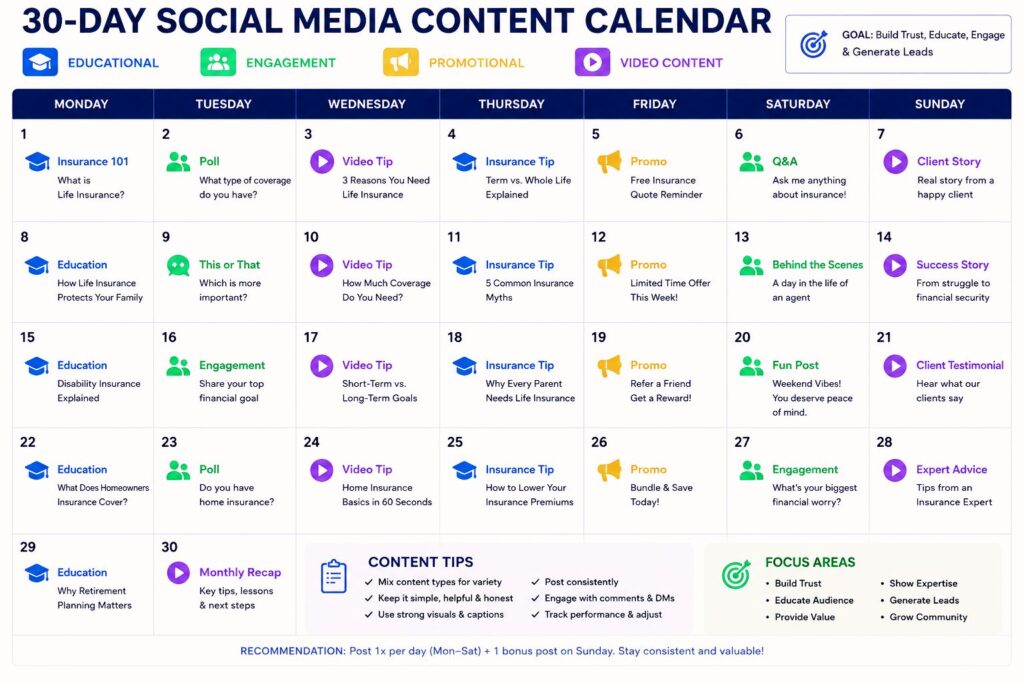
| Week | Content Theme | Post Ideas |
|---|---|---|
| Week 1 | Education | Coverage explainer, myth-busting post, “Did you know?” video |
| Week 2 | Trust Building | Client testimonial, behind-the-scenes, team introduction |
| Week 3 | Engagement | Poll, Q&A session, “What’s your biggest insurance concern?” |
| Week 4 | Promotion + Value | Free quote CTA, coverage review offer, seasonal risk reminder |
Repeat this cycle monthly, rotating topics within each theme to keep content fresh.
Also Read: Do Car Insurance Agents Get Commission? 7 Shocking Truths Revealed
It’s best to avoid overly generic or sales-heavy content and to establish a cohesive brand voice without simply copying and pasting captions across platforms.
Other costly mistakes to avoid:
Posting only sales content. If every post is “Get a free quote today,” your audience will tune out immediately. Follow the 80/20 rule without exception.
Ignoring comments and DMs. Around 65% of users leave after a single negative interaction — and being unresponsive reads as a negative interaction to prospects checking you out.
Using the same post on every platform. A LinkedIn post should read differently from an Instagram caption and a TikTok script. Each platform has its own language and expectations.
Going silent for weeks. Inconsistency destroys algorithmic reach. If you disappear for two weeks, your content will reach almost no one when you come back.
Focusing on followers instead of relationships. 500 engaged, trusting followers who know your name will generate more business than 5,000 passive followers who barely notice your posts.
By 2026, most marketing platforms used by insurance agents will include artificial intelligence. AI won’t replace agents, but it will automate repetitive, time-consuming tasks, freeing up agents to focus on relationship-building and advisory work.
Practical ways insurance agents are using AI in social media marketing today:
- Content creation — using AI tools to draft caption ideas, post variations, and video scripts
- Scheduling — automating post scheduling across multiple platforms
- Chatbots — handling basic inquiry responses on Facebook Messenger 24/7
- Analytics — identifying which content types generate the most engagement and leads
- Ad optimization — AI-powered Facebook and Instagram ad targeting that improves over time
Generative AI is quickly transforming the future of marketing, and integrating it into your digital marketing strategy is essential as a powerful tool to stay ahead.
Expert Tip #1: Don’t try to be on every platform at once. Pick the one where your ideal clients spend the most time, master it completely, then expand. A focused presence on one platform beats a scattered presence on five.
Expert Tip #2: Your face is your brand. Show up on camera — even if it feels uncomfortable at first. Agents who regularly appear on video generate significantly more inbound contacts than those who only post text and graphics.
Expert Tip #3: Use location-specific hashtags and content. Mentioning your city, county, or region in posts and captions dramatically improves your visibility to local prospects who are searching for insurance help near them.
Expert Tip #4: Repurpose everything. One long video becomes a short Reel, a LinkedIn post, three Instagram Stories, and a Facebook caption. Build once, distribute everywhere.
Expert Tip #5: Respond to every DM within the first hour if possible. Today’s prospects now expect near-instant replies, even outside normal business hours. Speed of response is one of the biggest differentiators between agents who convert leads and those who don’t.
| Pros | Cons |
|---|---|
| Low cost compared to traditional advertising | Requires consistent time investment |
| Builds trust before the first conversation | Results take time — not an overnight fix |
| Reaches local and niche audiences precisely | Algorithm changes can affect organic reach |
| Generates inbound leads (they come to you) | Compliance considerations for regulated content |
| Works 24/7 even when you’re not online | Requires ongoing content creation |
| Builds long-term brand equity | Negative comments are visible publicly |
Compliance Tips: What Insurance Agents Must Know
Social media marketing in insurance comes with regulatory responsibilities. Every state has rules about what licensed agents can and cannot say in public communications. Keep these principles in mind:
- Never make specific coverage guarantees in public posts — only quote and bind through proper channels
- Include required disclosures if your state requires them in advertising materials
- Don’t use misleading comparisons or unsubstantiated savings claims
- Get approval from your carrier before publishing content that references their products
- Keep records of your social media posts — regulators may request them
Consult your state’s Department of Insurance guidelines and your carrier’s compliance team before launching paid advertising campaigns.
Frequently Asked Questions
There’s no single best platform — it depends on your niche. Facebook is best for local community building and targeting homeowners and families. LinkedIn is ideal for commercial lines and B2B insurance. Instagram and TikTok work well for reaching younger buyers. The best platforms for insurance agents include Facebook, LinkedIn, Instagram, TikTok, and YouTube, where agents can focus on simplifying complex topics, engaging with their audience, and establishing trust. Start with one platform where your ideal clients spend time and build from there.
Consistency matters more than frequency. Posting 3–5 times per week on your primary platform is a solid starting point. Committing to publish at least one original piece of content weekly to educate your clients and prospects is a crucial minimum baseline. Quality and consistency beat volume — one genuinely helpful post per day is far more effective than five rushed ones.
Follow the 80/20 rule: 80% educational, helpful, or entertaining content and 20% promotional. Share educational content, highlight products, engage with your audience through Q&A sessions, and use visual content like infographics and videos to simplify complex insurance topics. Coverage explainers, myth-busting posts, local risk reminders, client testimonials, and behind-the-scenes content consistently perform well.
Absolutely. According to HubSpot’s 2025 State of Marketing report, businesses using social media for lead generation see a 45% higher lead-to-close rate compared to outbound-only strategies. The key is combining consistent organic content (to build trust and awareness) with targeted paid advertising (to accelerate lead flow). Agents who do both consistently report social media becoming their primary source of inbound leads within 6–12 months.
Always include required state disclosures in advertising content, avoid specific coverage guarantees in public posts, and get carrier approval before referencing their products. Keep records of all social media posts and consult your state’s Department of Insurance for specific advertising guidelines. When in doubt, frame your content as educational information rather than a direct solicitation, and always direct people to contact you directly for quotes and coverage details.
Conclusion: Your Clients Are Online — Are You?
Building a stronger social media presence for your agency is no longer optional — it is essential and a continued investment of time, strategy, and resources.
The agents winning in 2026 are not necessarily the ones with the biggest advertising budgets. They’re the ones who’ve built genuine authority and trust within their communities, both physical and digital.
Social media doesn’t replace the personal relationships that have always driven insurance success — it amplifies them. It lets you build trust at scale, establish authority before prospects ever pick up the phone, and stay top of mind with every person in your network.
Start with one platform. Post consistently. Educate generously. Engage genuinely. Track what works. And keep showing up — because the agent who’s visible and trusted online is the one who gets the call.

